### Sudoku Bipartite Model
#### Overview
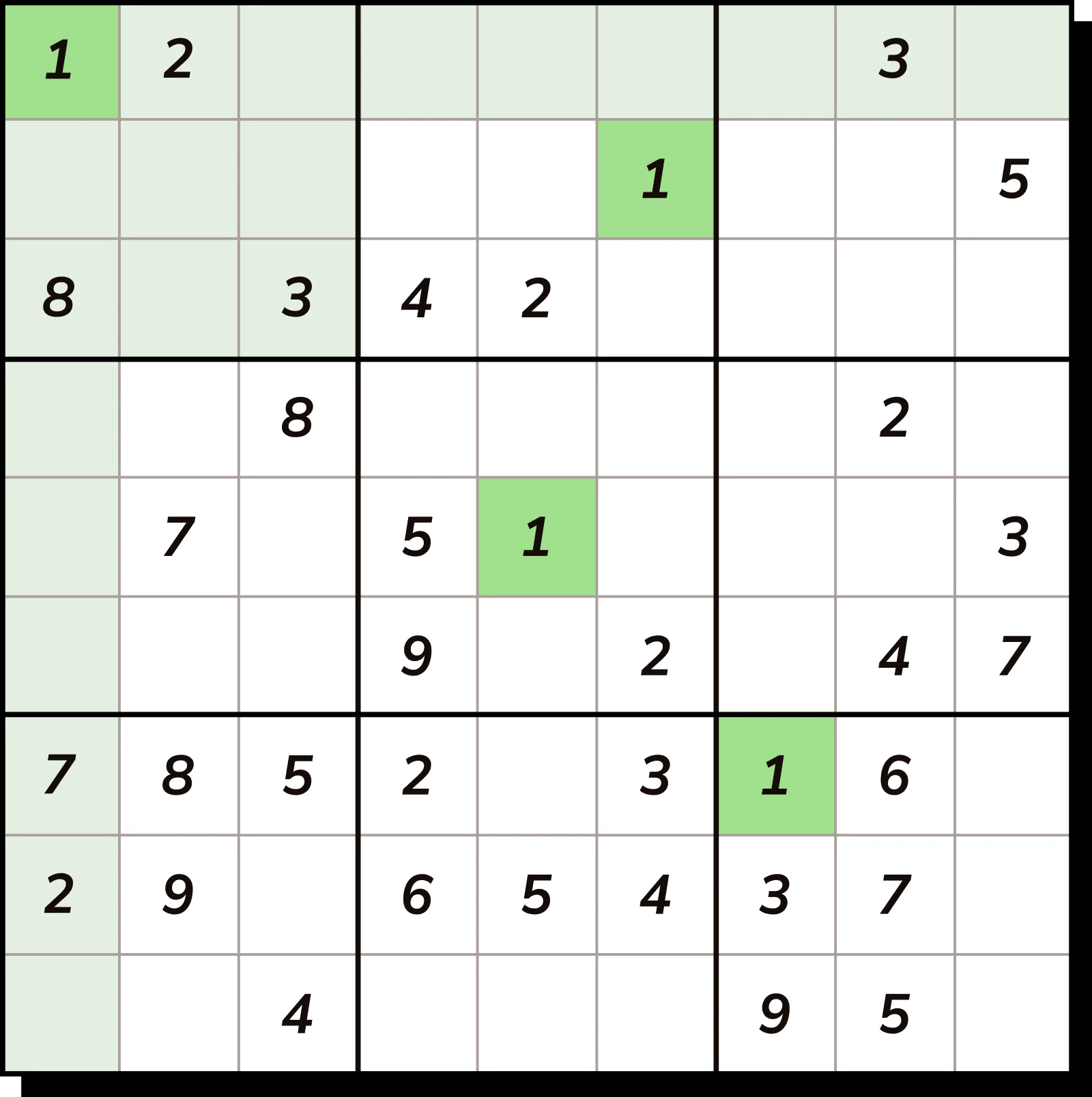
The Sudoku Bipartite Model is a mathematical representation of the classic Sudoku puzzle. It utilizes a bipartite graph to model the constraints and relationships between the cells of the Sudoku grid. This model has been widely used in computer science and mathematics to solve Sudoku puzzles efficiently.
#### Model Description
The Sudoku Bipartite Model consists of two disjoint sets of vertices, representing the rows and columns of the Sudoku grid. Each cell in the Sudoku grid is represented by an edge connecting a row vertex and a column vertex. The constraints of Sudoku, such as each row, column, and 3×3 subgrid containing all digits from 1 to 9, are enforced by the edges in the bipartite graph.
#### Key Components
1. **Vertices**: There are two sets of vertices, one for rows and one for columns. Each vertex corresponds to a row or a column in the Sudoku grid.
2. **Edges**: An edge exists between a row vertex and a column vertex if the corresponding cell in the Sudoku grid is empty. If the cell is filled, there is no edge between those vertices.
3. **Constraints**: The Sudoku constraints are modeled by ensuring that each vertex in a row or column has exactly one edge connected to it, and that each edge corresponds to a unique digit.
#### Solution Approach
To solve a Sudoku puzzle using the Bipartite Model, the following steps are typically followed:
1. **Graph Construction**: Construct the bipartite graph based on the Sudoku grid.
2. **Matching Algorithm**: Apply a bipartite matching algorithm to find a matching that covers all the vertices in one set (rows or columns) while ensuring that each edge corresponds to a unique digit.
3. **Backtracking**: If the matching algorithm fails to find a solution, backtrack and try different assignments for the cells.
#### Frequently Asked Questions (FAQ)
**Q1: What is the difference between the Sudoku Bipartite Model and other Sudoku-solving algorithms?**
A1: The Sudoku Bipartite Model is a specific graph-based representation of the puzzle, which is then used to apply matching algorithms. Other Sudoku-solving algorithms, such as backtracking, constraint propagation, and heuristic-based approaches, do not use this bipartite graph structure.
**Q2: Can the Bipartite Model be used to solve any Sudoku puzzle?**
A2: Yes, the Bipartite Model can be used to solve any valid Sudoku puzzle. However, the efficiency of the solution may vary depending on the complexity of the puzzle.
**Q3: How does the Bipartite Model compare in terms of performance with other Sudoku-solving methods?**
A3: The performance of the Bipartite Model can be competitive with other methods, especially for larger Sudoku grids. However, the efficiency can vary based on the specific implementation and the complexity of the puzzle.
**Q4: What are the benefits of using the Bipartite Model for Sudoku solving?**
A4: The Bipartite Model provides a clear and systematic way to represent the constraints of Sudoku. It can be particularly useful for understanding the underlying structure of the puzzle and for developing new algorithms that leverage this structure.
**Q5: Can the Bipartite Model be extended to other puzzle types?**
A5: Yes, the concept of the Bipartite Model can be extended to other puzzle types that share similar constraints, such as Latin squares or other combinatorial puzzles. The key is to identify the appropriate bipartite graph structure that captures the constraints of the new puzzle type.