### Backtracking Algorithm to Solve Sudoku
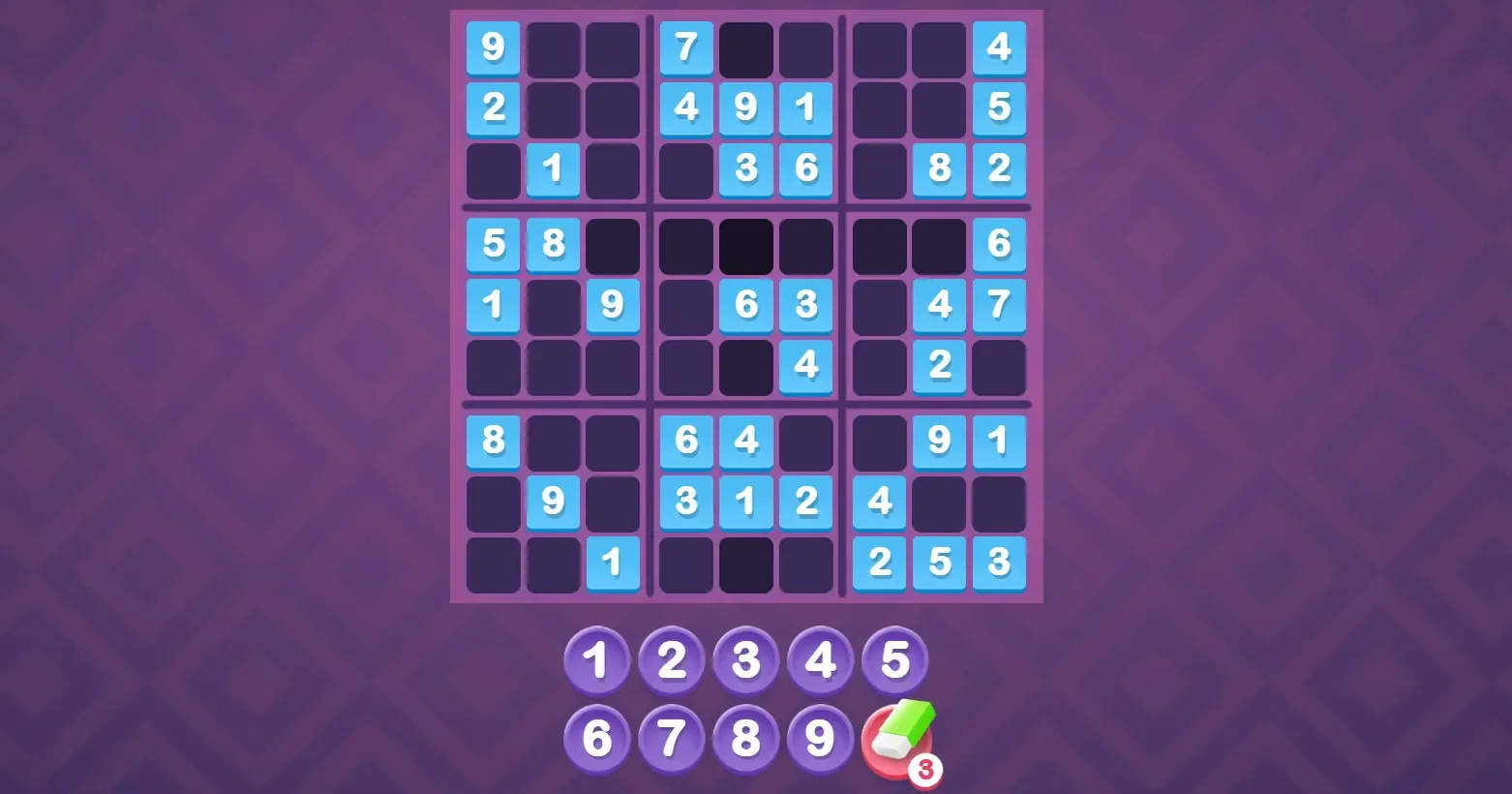
Sudoku is a popular puzzle game that challenges players to fill a 9×9 grid with digits so that each column, each row, and each of the nine 3×3 subgrids that compose the grid contain all of the digits from 1 to 9. Solving Sudoku puzzles can be both entertaining and challenging, and there are various algorithms available to tackle this problem. One of the most efficient algorithms for solving Sudoku is the backtracking algorithm. This article delves into the backtracking algorithm and demonstrates its application in solving Sudoku puzzles.
#### Understanding the Backtracking Algorithm
The backtracking algorithm is a systematic method for solving problems recursively by trying to build a solution incrementally, one piece at a time, and removing those solutions that fail to satisfy the constraints of the problem at any point of time (hence the name “backtracking”).
#### Steps in the Backtracking Algorithm for Sudoku
1. **Initialization**: Start with an empty Sudoku grid. Each cell should initially be marked as empty.
2. **Select an Unfilled Cell**: Identify the next unfilled cell in the Sudoku grid. This is usually done by scanning the grid row by row or column by column.
3. **Try All Possible Values**: For the selected cell, try all possible values from 1 to 9.
4. **Check for Constraints**: For each value tried, check if placing that value in the current cell violates any Sudoku rules (i.e., if the same number is already present in the same row, column, or 3×3 subgrid).
5. **Recursive Backtracking**:
– If the value does not violate any rules, place the value in the cell and recursively attempt to fill the rest of the grid.
– If the recursive call returns a success (i.e., the entire grid is filled correctly), the current path is a valid solution, and the algorithm terminates.
– If the recursive call fails (i.e., it is impossible to fill the grid with the current value), backtrack by removing the value from the current cell and trying the next possible value.
6. **Repeat Until a Solution is Found**: Continue the process of selecting an unfilled cell, trying all possible values, and checking for constraints until a complete solution is found or all possibilities are exhausted.
#### Advantages of Using the Backtracking Algorithm for Sudoku
– **Efficiency**: The backtracking algorithm is highly efficient for solving Sudoku puzzles, especially for larger grids, as it only explores valid solutions.
– **Scalability**: The algorithm can be easily adapted to solve different sizes of Sudoku grids.
– **Simplicity**: The backtracking algorithm is relatively straightforward to implement and understand.
#### Frequently Asked Questions (FAQ)
**Q1: How does the backtracking algorithm ensure that the solution is correct?**
A1: The backtracking algorithm only explores valid solutions that satisfy the constraints of Sudoku. As a result, once the algorithm finds a solution, it is guaranteed to be correct.
**Q2: Can the backtracking algorithm solve all Sudoku puzzles?**
A2: Yes, the backtracking algorithm can solve any valid Sudoku puzzle, assuming the puzzle has a unique solution.
**Q3: How does the backtracking algorithm handle situations where multiple solutions exist?**
A3: The backtracking algorithm will find one solution and terminate. If multiple solutions exist, the algorithm will only report the first solution it finds.
**Q4: Can the backtracking algorithm be optimized for performance?**
A4: Yes, several optimization techniques can be applied to the backtracking algorithm to improve its performance, such as using heuristic methods to choose the next cell to fill and using constraint propagation to reduce the number of possible values for each cell.
**Q5: What is the time complexity of the backtracking algorithm for Sudoku?**
A5: The time complexity of the backtracking algorithm for Sudoku depends on the specific implementation and the difficulty of the puzzle. In the worst case, the time complexity is O(n!), where n is the number of cells in the Sudoku grid. However, for typical Sudoku puzzles, the algorithm performs much faster due to the pruning of invalid solutions.